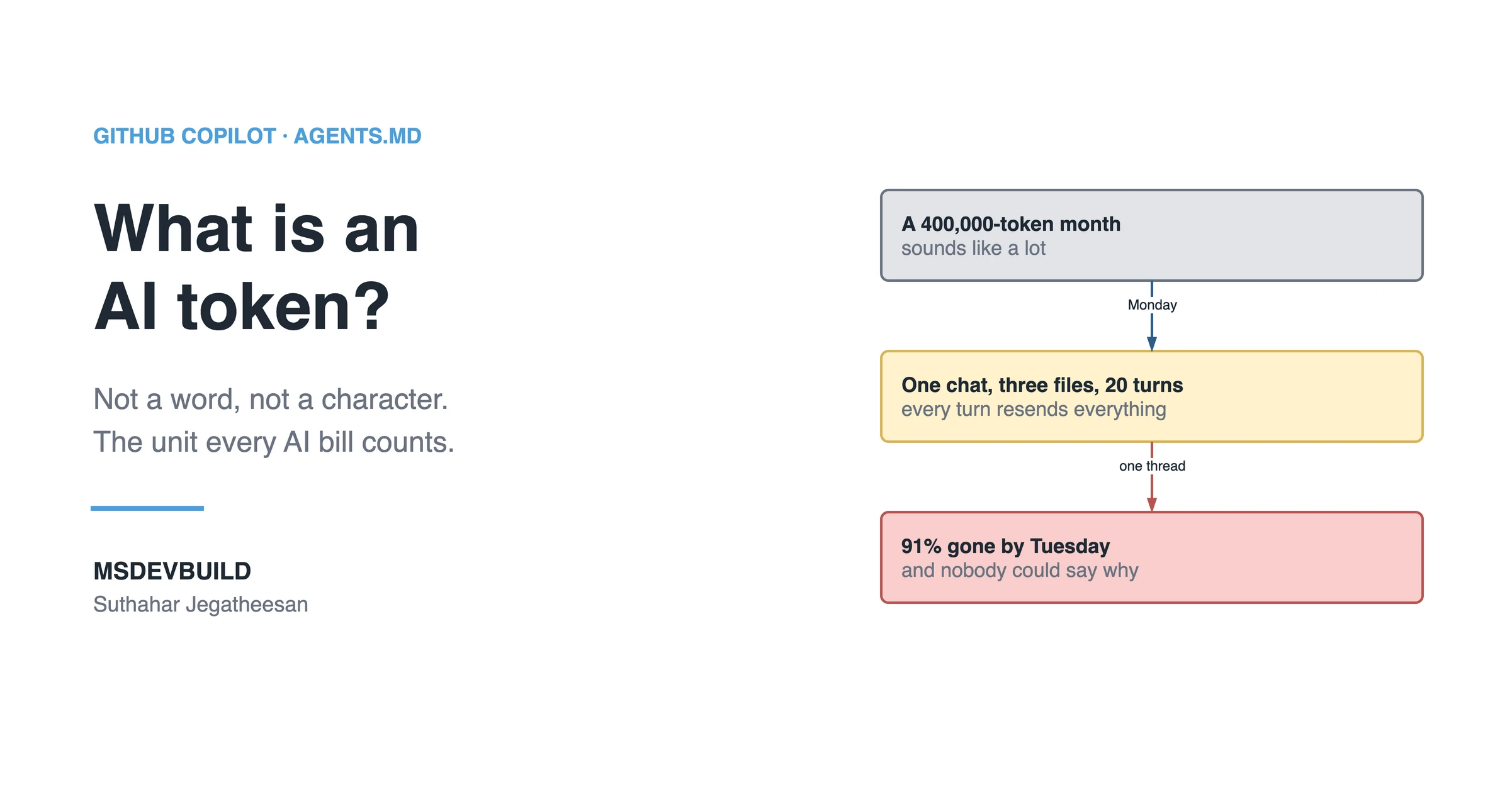
An AI token is a fragment of text from a fixed vocabulary: not a word, not a character. Every AI price, limit and quota is counted in tokens, because tokens are what the model actually processes. This is what a token really is, why it is the unit of billing, and how to work out what a request costs before you send it, measured on a real codebase instead of guessed.
Picture a developer on the MSDevBuild Eats team who has just been given a monthly allowance of 400,000 AI tokens. That is common when a team routes AI usage through its own gateway or API keys. Is it a lot? They have used AI coding tools daily for two years and never once needed to know what a token was.
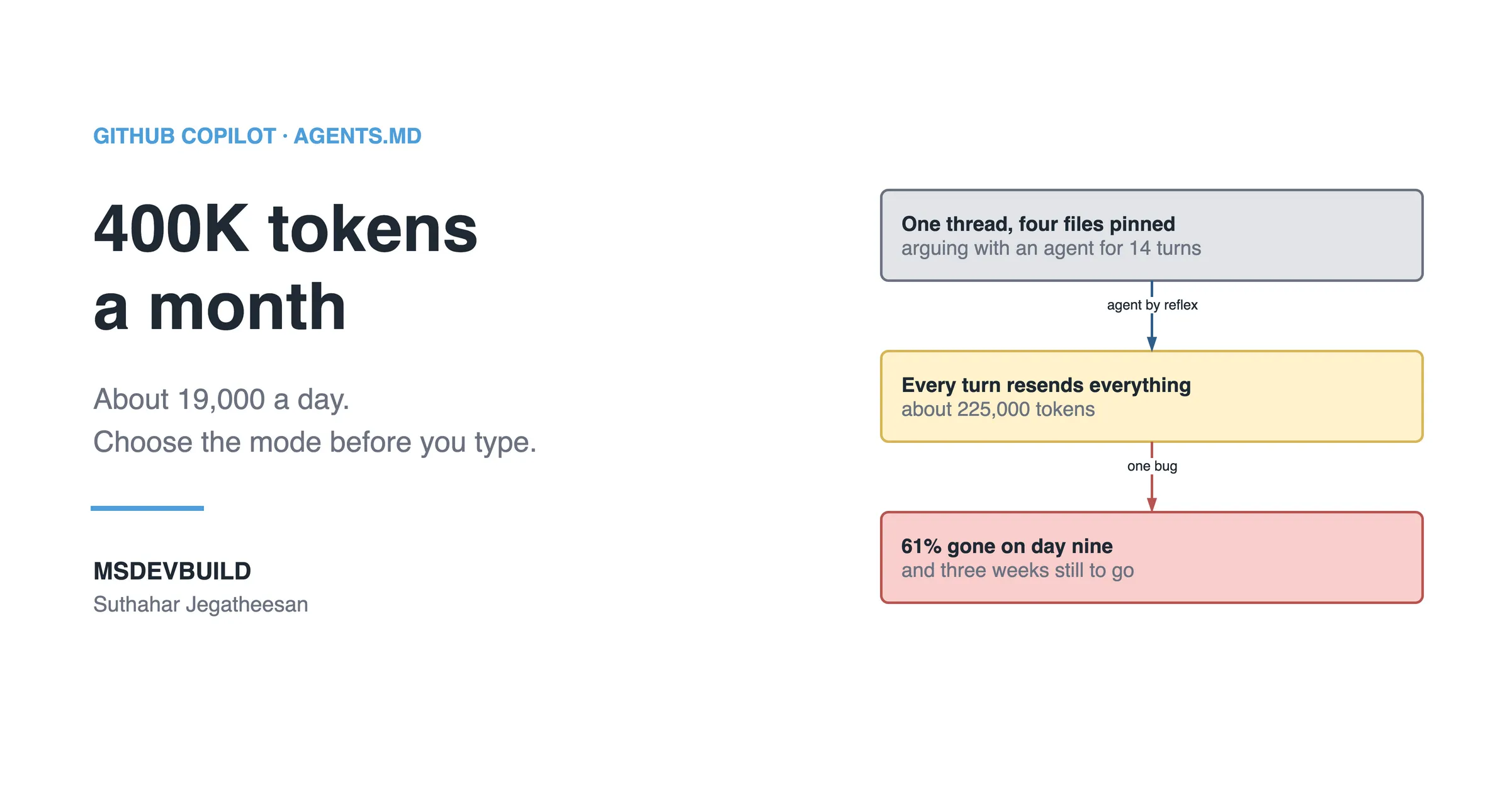
On Monday morning they open one chat, attach three files from the app, and start refactoring the checkout. By Tuesday lunchtime the usage dashboard says 91% of the month is gone. They sent twenty messages.
Twenty messages, 91% of a month
| When | What happened |
|---|---|
| Mon 10:00 | New chat. Attached: checkout_screen.dart, cart_bloc.dart, order.dart |
| Mon 10:05 | First question: “where is the checkout total calculated?” |
| Mon, all day | A back-and-forth refactor. Short questions, medium answers |
| Tue 12:00 | Twentieth message. The chat is still the same thread |
| Tue 14:00 | Usage dashboard: about 364,000 tokens used of 400,000 |
Every message was short. None of them was expensive on its own. The cost was in what travelled with each one.
The script that measured it
Tokenization is a lookup against a specific vocabulary, so the only exact count comes from running the tokenizer. tiktoken does it in a few lines:
import tiktoken

enc = tiktoken.get_encoding("o200k_base")   # the GPT-4o family's tokenizer
for path in ["lib/features/checkout/presentation/checkout_screen.dart",
             "lib/features/cart/bloc/cart_bloc.dart",
             "lib/domain/entities/order.dart",
             ".github/copilot-instructions.md"]:
    text = open(path).read()
    tokens = len(enc.encode(text))
    print(f"{path}: {tokens} tokens, {tokens / text.count(chr(10)):.1f} per line")
On the food delivery app:
| File | Lines | Tokens | Tokens per line |
|---|---|---|---|
checkout_screen.dart | 499 | 3,014 | 6.0 |
cart_bloc.dart | 180 | 1,293 | 7.2 |
order.dart | 247 | 1,682 | 6.8 |
copilot-instructions.md | 75 | 902 | 12.0 |
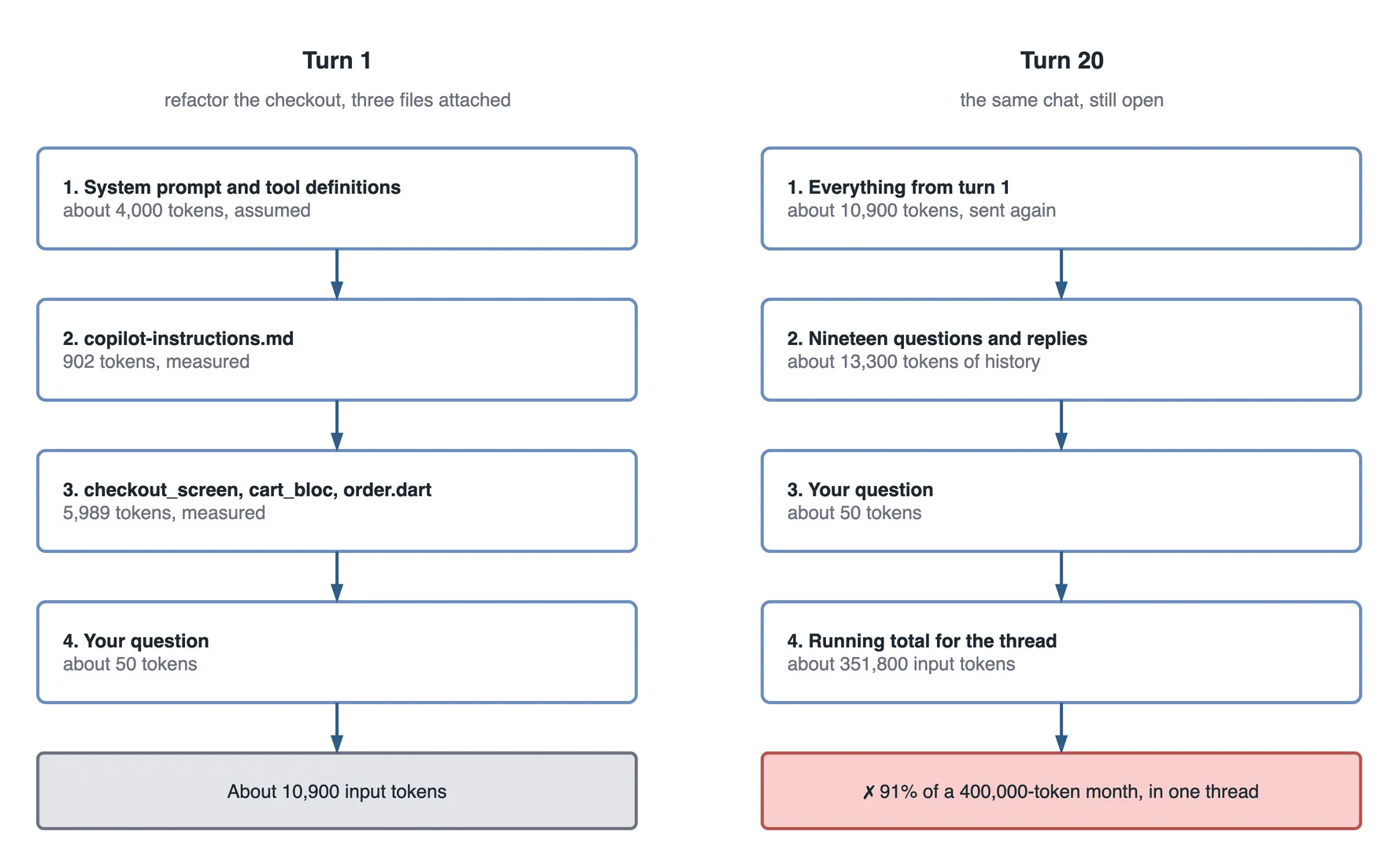
The three attached files are 5,989 tokens. The instructions file, sent with every request, is 902. Add a system prompt and tool definitions, around 4,000 tokens together in this estimate, and a 50-token question, and turn 1 costs about 10,900 input tokens.
Turn 20 carries all of that again, plus nineteen earlier questions and answers: about 24,200 tokens. Across the whole thread, with about 600 tokens per reply, that adds up to roughly 351,800 input tokens and 12,000 output tokens. Ninety-one per cent of the month, in one conversation.
If you would rather see the idea first, it is a short video:
What is a token, exactly?
A token is a fragment of text drawn from a fixed vocabulary the model was trained with. Not a word. Not a character. A fragment.
Modern models have vocabularies of roughly 100,000 to 200,000 entries. Every piece of text you send is chopped into pieces that exist in that vocabulary, and each piece is swapped for its ID number. The model never sees your letters. It sees a list of integers.
Take a sentence:
The order service returns null.With o200k_base that is 6 tokens: The, order, service, returns, null, .. Notice the leading spaces. In most tokenizers a space belongs to the word that follows it, so order is one token rather than two. Formatting a prompt with normal spacing is almost free.
Now take a name:
JegatheesanOne word to you, 3 tokens to this tokenizer, because it is not in the vocabulary as a unit and has to be assembled from pieces. Common text is cheap. Unusual text is expensive. That rule explains most of what follows.
The algorithm behind this is byte pair encoding. It is built by scanning a very large amount of text and repeatedly merging the most frequent adjacent pairs into single units. Frequent sequences like the, ing and tion end up as one token. Rare sequences never earn a merge, so they stay fragmented. Nothing about it is semantic. The tokenizer has no idea what a word means, only how often that sequence of bytes appeared.
Why AI cost is measured in tokens
Because tokens are the unit of work, not a unit of accounting invented for pricing.
When you send a request, the model performs a forward pass over every token in the context. Then, to produce a reply, it generates one token, appends it, and runs again. A reply of 400 tokens is 400 sequential passes, each attending over everything before it.
So the compute cost of a request scales with how many tokens go in and come out, not with how many requests you make. A one-line question and a 50,000-token repository dump are both “one request”, and they differ in cost by orders of magnitude.
This also explains the pricing asymmetry that confuses people the first time they see it.
Input tokens are processed in one parallel pass. The whole prompt goes through together, and GPUs are very good at that shape of work.
Output tokens are generated one at a time. Each new token needs another pass, and it cannot start until the previous one exists.
That is why providers usually price output several times higher than input. It reflects a real difference in sequential compute. The practical consequence: asking for a diff instead of a rewritten file is not a stylistic preference, it is the cheapest change available to you.
How is a token count calculated?
There is no formula. Tokenization is a lookup against a specific vocabulary, so the only exact answer comes from running the actual tokenizer. You can estimate well enough to plan with these ratios; the code row is measured, the rest are typical.
| Content | Characters per token | Practical rule |
|---|---|---|
| English prose | about 4 | 1,000 tokens ≈ 750 words |
| Dart in the food delivery app | 3.9 to 5.3 | 6 to 7 tokens per line, measured |
| Dense C# or TypeScript | lower | budget up to 10 tokens per line |
| JSON and XML payloads | about 2.5 | punctuation-heavy, worse than it looks |
| Base64, GUIDs, hashes | about 2 | effectively random, worst case |
| Tamil, Hindi, Arabic script | 1 to 2 | two to five times English for the same meaning |
Why code is denser than it looks
Identifiers, generics and punctuation each cost tokens. services.AddScoped<IOrderRepository, OrderRepository>(); is 10 tokens with o200k_base: the dot, the angle brackets, the parentheses and the semicolon all count.
Indentation matters less than it used to. Newer tokenizers have merged entries for runs of spaces, which is why the Flutter files above, deeply indented as Flutter code is, still came in at six to seven tokens per line. Older tokenizers, and denser languages, run higher.
So measure your own codebase once, with the script above, and use your own number. For this app it is about 6.5 tokens per line; a 300-line widget is roughly 2,000 tokens every time it enters a request.
Why Indian language prompts cost more than English
These vocabularies were built mostly from English text, so English gets the good merges. Tamil, Hindi, Telugu and Arabic often fall back to smaller fragments.
Measured with the same tokenizer, “The order service returns nothing.” is 6 tokens. The same sentence in Tamil, “ஆர்டர் சேவை பூஜ்யத்தை வழங்குகிறது.”, is 12. Twice the cost for the same meaning, and older tokenizers are worse.
If you write prompts in an Indian language against a metered budget, you pay a tax an English speaker does not. It is worth knowing before you conclude your usage is high because you are careless. A useful habit: write prompts in English and ask for explanations in the language you want to read.
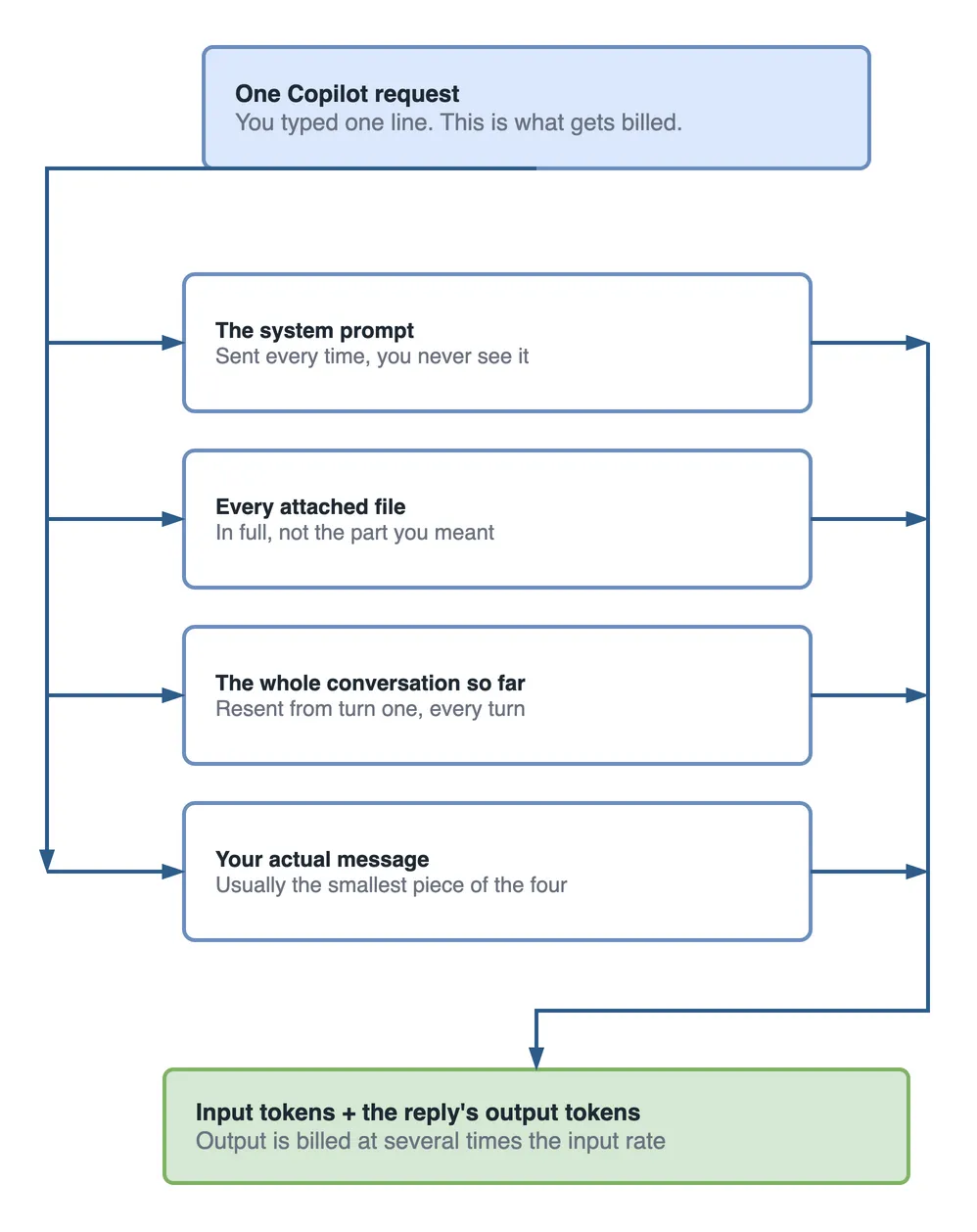
What gets counted in one Copilot request
Far more than what you typed.
| Part of the request | Typical size | Do you control it? |
|---|---|---|
| Provider system prompt | 1,000 – 3,000 | No |
| Tool and function definitions | 500 – 5,000 | Yes, by installing fewer tools |
Your instructions file or AGENTS.md | 900 – 1,100 in the food delivery app | Yes, by keeping it short |
| Attached or selected files | 1,300 – 3,000 per file above | Yes, and this is the big one |
| Conversation history so far | grows every turn | Yes, by starting fresh threads |
| Your actual question | 20 – 200 | Barely worth optimising |
| The reply | 200 – 2,000 | Yes, by asking for less |
Your question is the smallest line in that table. That is why “write shorter prompts” is such poor advice.
Two rows are silent. Tool definitions are sent on every request whether or not a tool is used, so a pile of installed integrations is a standing charge. And an always-on instructions file is the same shape of cost, which is the real reason custom instructions should be tight and why deep methods belong in Skills that load on demand.
Context window and token budget are different things
The context window is the maximum number of tokens allowed in a single request, input and output together. Current models advertise anything from 128,000 to well over a million.
Your token budget is how many tokens you may spend over a period.
A big context window is permission to spend, not spare capacity. If your model accepts 200,000 tokens in one call and your monthly allowance is 400,000, two maximal requests end your month.
There is a quality argument too. Models get measurably worse at using information buried in the middle of a very long context. Attaching more is not the same as being understood better.
Counting tokens yourself
Three options, in order of effort.
Paste it into a tokenizer page. The OpenAI tokenizer shows the exact split and colours the boundaries. Five minutes with your own code teaches the whole concept.
Count in Python with tiktoken, as in the script above.
Count in C# with the Microsoft.ML.Tokenizers package, which gives exact counts inside an application:
using Microsoft.ML.Tokenizers;

var tokenizer = TiktokenTokenizer.CreateForModel("gpt-4o");

var source = File.ReadAllText("OrderService.cs");
var count = tokenizer.CountTokens(source);
var lines = source.Split('\n').Length;

Console.WriteLine($"{count} tokens, {lines} lines, {(double)count / lines:F1} tokens per line");
The encoding data for gpt-4o ships in a companion package, Microsoft.ML.Tokenizers.Data.O200kBase. The API has moved between releases, so check the current version on Microsoft Learn before wiring it into anything permanent.
Counting inside your own application matters because any feature that calls a model on a user’s behalf needs a cap, and counting before you send is how you enforce one.
How efficient can a request be?
The same refactor, done three ways, using the measured file sizes and the same assumptions as the scenario:
| Approach | Input tokens for 20 questions | Share of a 400,000 month |
|---|---|---|
| One thread, three whole files attached | about 351,800 | 88% input, 91% with replies |
| Five threads of four turns, same files | about 240,000 | 60% |
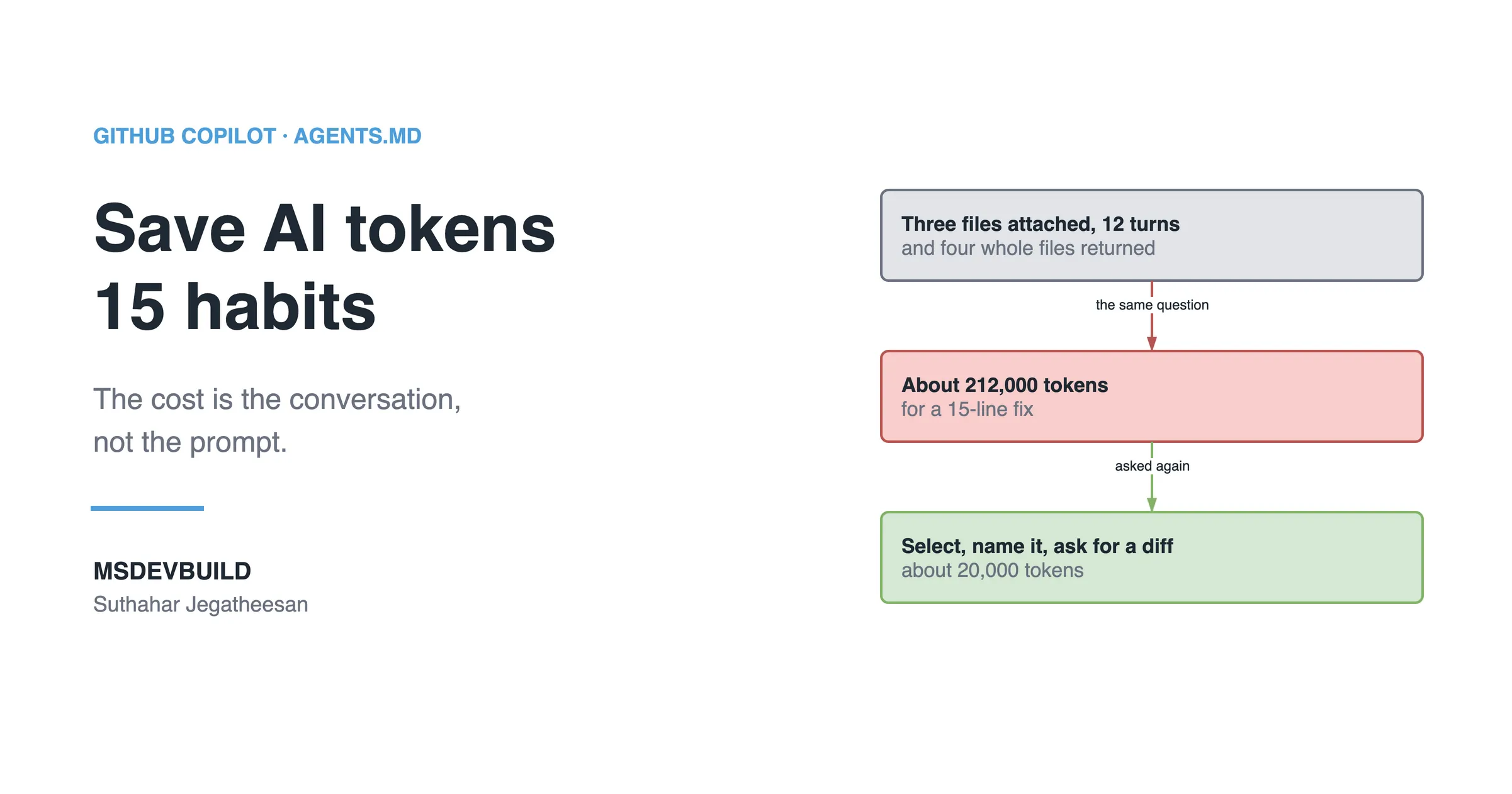
| Five threads, only the method in question attached (about 300 tokens) | about 126,000 | 32% |
Short threads stop history compounding. Attaching the part you mean stops paying for the rest of the file on every turn. The rule underneath: a thread’s total cost grows with the square of its length, and with the size of everything attached to it, on every turn.
The numbers worth memorising
- About 6.5 tokens per line of Dart, measured; budget up to 10 for dense code. Converts any file into a cost.
- 750 words per 1,000 tokens. Converts any document into a cost.
- Output costs several times input. Ask for diffs, not files.
- Every turn resends the whole conversation. Cost grows with the square of the thread length.
Questions a tech lead will ask about this
- “Why did one developer burn the team’s allowance?” Almost always one long thread with large files attached. Look at turns per thread before anything else.
- “Should we ban attaching files?” No. Attach the part you mean, and start a new thread when the topic changes.
- “Do Indian-language prompts really cost more?” Measured here at twice the tokens for the same sentence. Prompts in English, answers in any language, is a cheap habit.
- “How do we plan a budget?” Measure tokens per line on your own code once, then estimate: files attached × turns, plus history.
- “Does our instructions file matter?” At 900 tokens on every request, yes; it is paid thousands of times a month.
What to do on day one
- Run the tiktoken script on five files from your own codebase and write down your tokens per line.
- Measure your instructions file and
AGENTS.md; they are paid on every request. - Start a new chat when the topic changes.
- Attach the method or the lines you mean, not the whole file.
- Ask for diffs instead of rewritten files.
Key takeaways
- A token is a subword fragment from a fixed vocabulary; common text is cheap and rare names, identifiers and non-English scripts are expensive.
- Billing counts tokens because tokens are the unit of compute: one pass per token in and per token out.
- Output costs more than input because it is generated sequentially.
- Measured: Dart at about 6.5 tokens per line, a real instructions file at 902 tokens, Tamil at twice English.
- Every turn resends everything, so a thread’s cost grows with the square of its length.
The next Monday
The following week, the same developer starts the next refactor differently. One chat per question-sized piece of work. Instead of three whole files, they select the method they are asking about. When the answer turns into a new topic, they start a new chat.
By Friday they have asked as many questions as the week before. The dashboard reads about a third of the month.