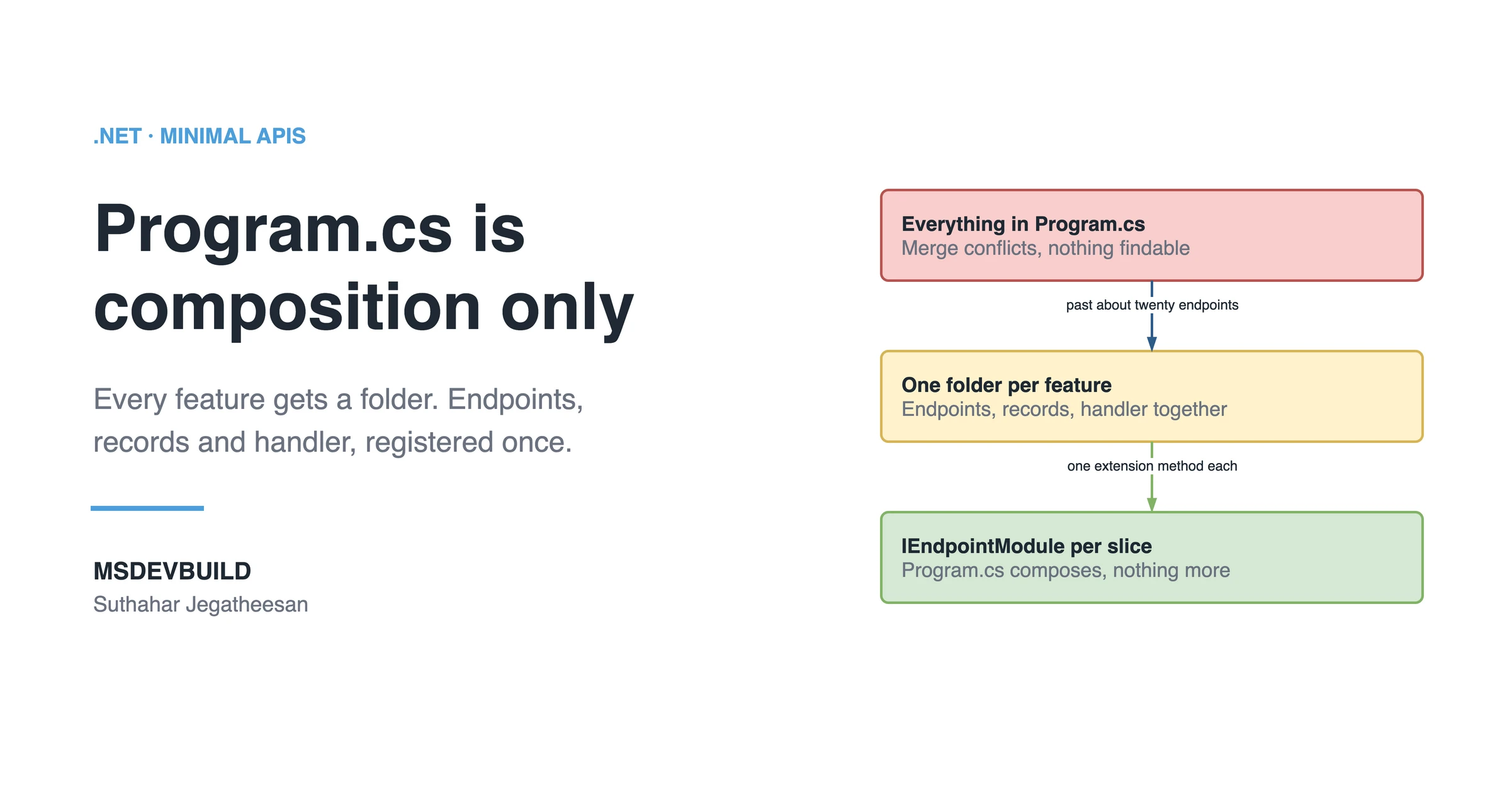
The Minimal API tutorials all put endpoints in Program.cs. That is fine for a demo and untenable by the twentieth endpoint.
Why does Program.cs stop scaling?
Three reasons compound. Merge conflicts concentrate in one file that every feature branch touches. Related code drifts apart: the endpoint sits in Program.cs while its validation lives three folders away. And discoverability collapses: finding “where orders are handled” becomes a scroll rather than a folder. None of this is a failing of Minimal APIs themselves — the single-file layout is a starting point the docs never claimed was an architecture.
What a vertical slice layout looks like
Organise by feature, not by technical role:
src/
├─ Program.cs                 // composition only
├─ Features/
│  ├─ Orders/
│  │  ├─ OrderEndpoints.cs    // routes for this feature
│  │  ├─ CreateOrder.cs       // request, response, handler
│  │  ├─ GetOrder.cs
│  │  └─ OrderValidators.cs
│  └─ Customers/
│     ├─ CustomerEndpoints.cs
│     └─ ...
└─ Shared/
   ├─ Endpoints/IEndpointModule.cs
   └─ Persistence/AppDbContext.cs
Everything a change to “create order” touches lives in one folder.
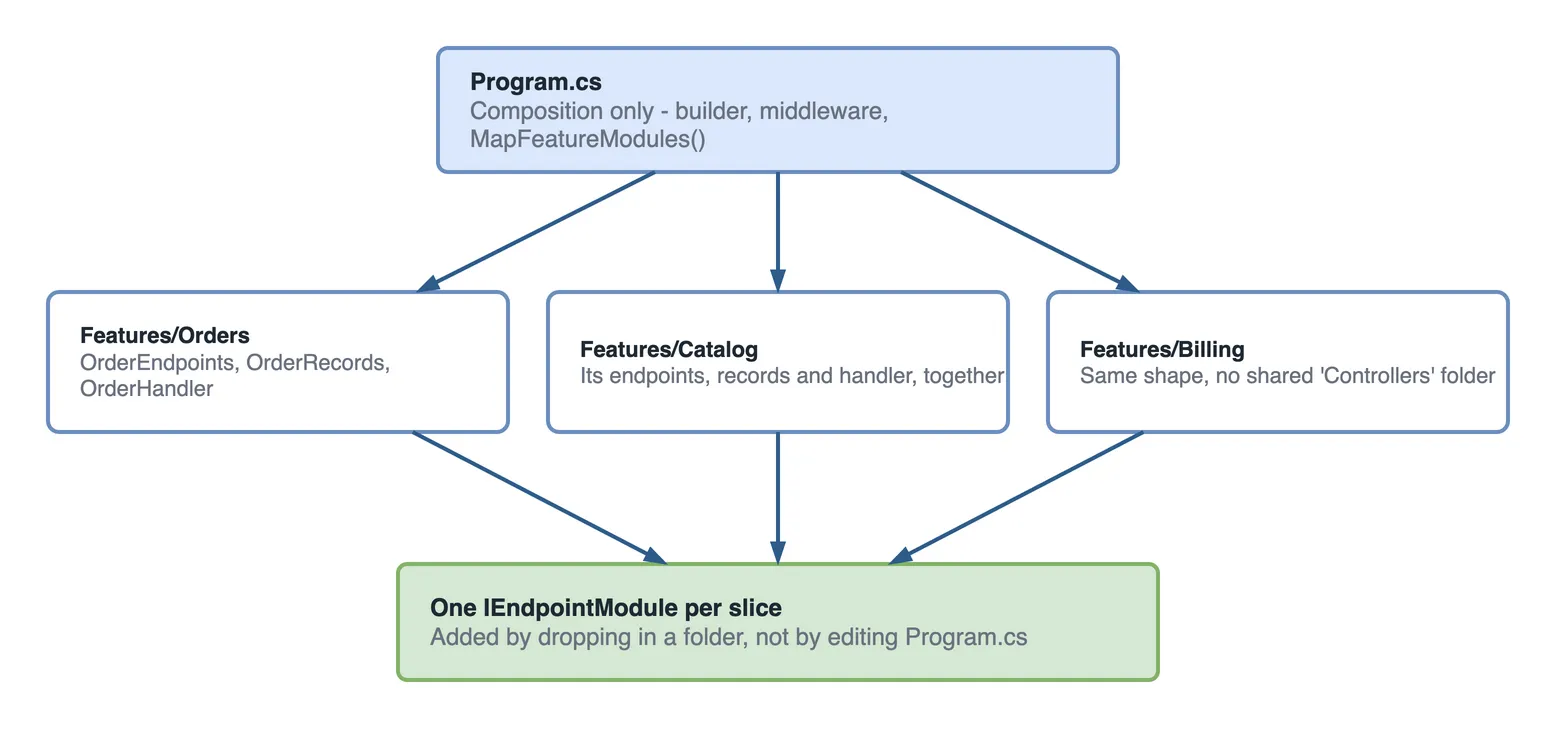
Registering feature modules in a Minimal API project
Once the layout holds, the next thing to get right is who may call each slice, which I cover in securing a .NET Minimal API with JWT bearer authentication.
Define a tiny contract:
public interface IEndpointModule
{
    void MapEndpoints(IEndpointRouteBuilder app);
}
Then implement it per feature:
public sealed class OrderEndpoints : IEndpointModule
{
    public void MapEndpoints(IEndpointRouteBuilder app)
    {
        var group = app.MapGroup("/orders")
            .WithTags("Orders")
            .RequireAuthorization();

        group.MapGet("/{id:guid}", GetOrder.Handle).WithName("GetOrder");
        group.MapPost("/", CreateOrder.Handle).WithName("CreateOrder");
    }
}
And discover them all at startup by assembly scan:
public static class EndpointExtensions
{
    public static void MapAllEndpoints(this WebApplication app)
    {
        var modules = typeof(Program).Assembly
            .GetTypes()
            .Where(t => typeof(IEndpointModule).IsAssignableFrom(t)
                        && t is { IsInterface: false, IsAbstract: false })
            .Select(Activator.CreateInstance)
            .Cast<IEndpointModule>();

        foreach (var module in modules)
        {
            module.MapEndpoints(app);
        }
    }
}
Program.cs then stays short no matter how many features exist:
var app = builder.Build();

app.UseAuthentication();
app.UseAuthorization();
app.MapAllEndpoints();

app.Run();
Once the structure holds, it is worth pointing it at something real, and a RAG pipeline in .NET with Azure OpenAI is built on exactly this layout.
Handlers as static classes
Each operation gets one file holding its request, response, and handler:
public static class CreateOrder
{
    public record Request(Guid CustomerId, List<LineItem> Items);
    public record Response(Guid OrderId, decimal Total);

    public static async Task<Results<Created<Response>, ValidationProblem>> Handle(
        Request request,
        AppDbContext db,
        IValidator<Request> validator,
        CancellationToken ct)
    {
        var validation = await validator.ValidateAsync(request, ct);
        if (!validation.IsValid)
        {
            return TypedResults.ValidationProblem(validation.ToDictionary());
        }

        var order = Order.Create(request.CustomerId, request.Items);
        db.Orders.Add(order);
        await db.SaveChangesAsync(ct);

        return TypedResults.Created(
            $"/orders/{order.Id}",
            new Response(order.Id, order.Total));
    }
}
Static handlers avoid a per-request allocation, and TypedResults gives you accurate OpenAPI output without extra attributes.
Key takeaways
- Organise by feature; a change should touch one folder.
IEndpointModule+ assembly scanning keepsProgram.csat composition only.- Route groups carry cross-cutting concerns like auth and tags.
- Static handlers with
TypedResultsare cheap and self-documenting.